
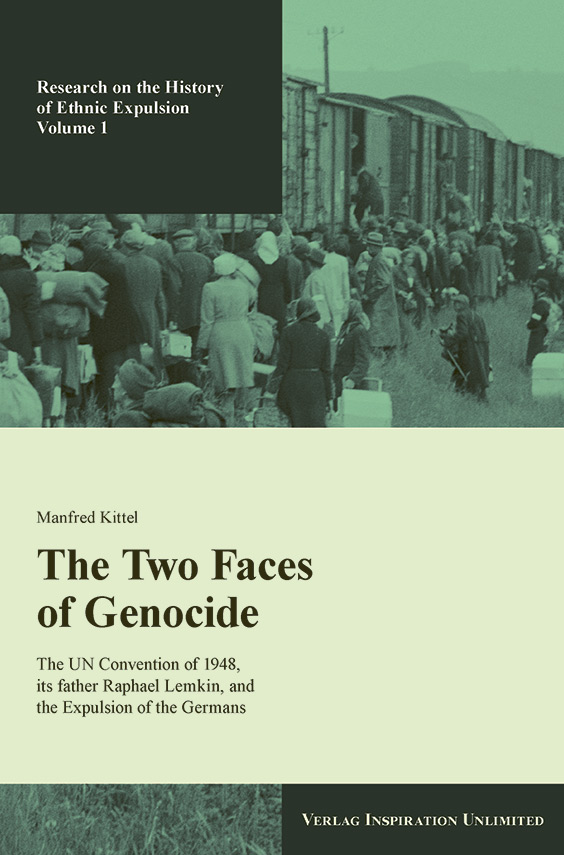
Manfred Kittel
The Two Faces of Genocide (NEW: 10 November 2026)
The UN Convention of 1948, his father Raphael Lemkin, and the expulsion of the Germans
Paperback, 21.3 x 15.7 cm, 180 pages
ISBN 978-3-945127-65-0
29,90 €
Place an informal order here; we’ll ship it to you free of charge with an invoice. >>
What is genocide? Is it merely the physical extermination of an entire group through brute force, or does it also include its deliberate—though largely bloodless—destruction through expulsion followed by assimilation? Legal scholar Raphael Lemkin, the Polish-Jewish architect of the 1948 UN Genocide Convention, took a clear stance on this: Expulsions, too, are usually genocidal—at least whenever they are carried out with the intent to destroy an entire group as such. In his 2023 German book „Die zwei Gesichter der Zerstörung“ („The Two Faces of Destruction“), historian Manfred Kittel has explored this little-known chapter of contemporary history, along with all that it implies for general international law, German remembrance culture, and the treatment of German expellees. This work is now available in English.
Raphael Lemkin, the Polish-Jewish architect of the 1948 UN Genocide Convention, viewed organized expulsions as acts of genocide as well, including the expulsion of 14 million Germans after World War II. For him, genocide in the sense of international law did not begin with the physical extermination of entire peoples, but rather with the destruction of national groups as such in their social existence. A close reading of the Genocide Convention leaves little room for any other interpretation, and in 1954, when Germany acceded to the UN Convention, the German Bundestag adopted this definition of genocide with bipartisan support. The scholar, who was living in New York at the time, had even urged this legal interpretation himself in letters to members of parliament.
Not only in Germany but worldwide, Lemkin’s humanitarian plea later fell into oblivion. His precise yet broadly defined concept of genocide has been and continues to be distorted and contested in political debates, most often in places where ethnic cleansing is planned or carried out. According to the UNHCR, nearly 120 million people worldwide are currently victims of flight and displacement—a humanitarian catastrophe of immense proportions. A return to Raphael Lemkin’s authentic definition of genocide could help overcome this misery.
About the Author: Prof. Dr. Manfred Kittel, born in 1962, worked initially in journalism and political consulting after completing his studies, then at the Institute for Contemporary History in Munich, and, beginning in 2009, as the founding director of the Federal Foundation “Flight, Expulsion, Reconciliation” in Berlin. Since 2015, he has returned to researching topics in contemporary history. He teaches modern history in Regensburg. His most important publications include studies on the history of democracy in Germany and France before 1933/36, on the very different approaches to coming to terms with the past in Japan and Germany after World War II, on the “1968” movement, and, above all, on the history and culture of remembrance surrounding the flight and expulsion of Germans.